
Most Gaudí itineraries go straight to the Sagrada Família, Casa Batlló and Park Güell, and Palau Güell gets squeezed in as an afterthought, if at all. That is a mistake. It sits a few minutes from La Rambla, it is usually far quieter than the big three, and it is the building where you can watch Gaudí working out the ideas he later made famous.
If you have already read our overviews of Barcelona's palaces or the El Raval neighborhood guide, you have met Palau Güell in a paragraph. This guide is the full visit: what the building is, what you see in the order you actually walk through it, and the practical details that decide whether it fits your day.
What Palau Güell Is
Palau Güell was built between 1886 and 1890 for the industrialist Eusebi Güell, Gaudí's most important patron. It was conceived as a family home and also as a place for receptions, meetings and concerts, in the same years Barcelona was preparing for the 1888 Universal Exposition. UNESCO added it to the World Heritage List in 1984 as part of the Works of Antoni Gaudí.
The street it sits on is narrow, so you cannot step back and admire the facade the way you can at Casa Batlló. Gaudí put the drama inside and on the roof instead. That is why the visit rewards going in rather than just photographing the doors.
The Visit, In Order
The Gates and the Basement Stables
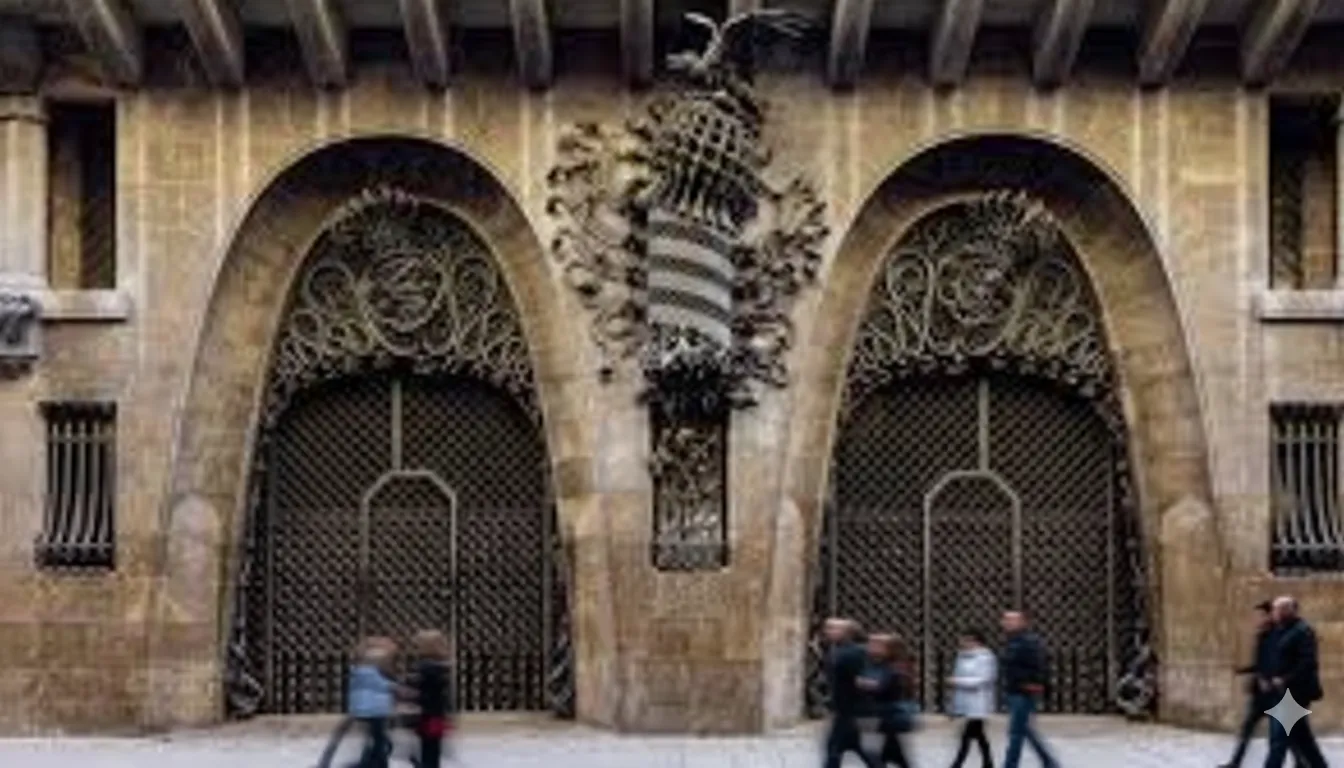
The facade is dominated by two monumental wrought-iron gates with parabolic arches. They were designed so horse-drawn carriages could drive straight into the building, and the ironwork is organic and plant-like, built so people inside could see the street without being seen from it.
Inside, a ramp leads down to the stables below ground, where horses came and went. This is the part most people do not expect: a forest of short, mushroom-shaped brick columns carrying the weight of the house above. It is an early look at Gaudí treating structure as something that should be beautiful, not hidden.
The Central Hall
The whole house is organized around the central hall, which rises through the building and is capped by a perforated parabolic dome. Small openings in the dome let light through so the ceiling reads like a night sky of stars. The hall contains the organ console and a chapel closed off by two doors, and it was used for concerts and religious services. Stand in the middle and look up: this is the single best moment of the visit.
The Roof
Twenty chimneys and ventilation ducts crowd the roof, and this is where Gaudí first turned them into polychrome sculptures, each with its own base, shaft and cap. Four wide parabolic openings in the roof pull natural light down toward the hall. If you have seen the chimney-pot "knights" on the roof of Casa Milà, this is where Gaudí first treated chimneys as sculpture.
Restoration, and Why It Looks So Good
The palace closed for about seven years of restoration and reopened in 2011. The work included scaffolding, careful cleaning and the painstaking reconstruction of chimneys that had crumbled almost beyond recognition. Much of what you see on the roof today is the result of that project.
Is It Worth It If You Have Seen Casa Batlló?
Yes, for a different reason. Casa Batlló and Casa Milà show Gaudí at the height of his confidence. Palau Güell shows how he got there: the parabolic arch, the use of light from above, and the chimney sculptures all show up here in an early form, in a darker and heavier stone-and-iron setting. It also feels very different on the ground, with far fewer crowds. If you only have time for one lesser-known Gaudí building, this is a strong choice, and it pairs well with a morning at La Boqueria or a wander through El Raval.
Planning Your Visit
Opening hours. From April 1 to October 31 the palace is open 10 AM to 8 PM, with last entry at 7 PM. From November 1 to March 31 it is open 10 AM to 5:30 PM, with last entry at 4:30 PM. It is closed on non-holiday Mondays, on December 25 and 26, on January 1 and 6, and for maintenance during the last week of January.
Tickets. Adults pay €15, visitors aged 18 to 25 pay €12, seniors over 65 and children aged 13 to 17 pay €5, and children under 12 enter free. An audio guide in English, among about 13 languages, is included with admission.
Free first Sunday. Entry is free on the first Sunday of every month and on certain significant dates, but you still need a ticket, and free days are booked in advance through the official website. Book early, because it is the cheapest way in.
How long to allow. The audio guide runs about 40 minutes, and most visitors spend between one and one and a half hours in total.
Accessibility. The palace offers a partially adapted route for visitors with reduced mobility or using a wheelchair, subtitled audio guides in several languages, and relief and braille maps at the entrance. Contact the palace in advance if you need specific arrangements.
Prices and hours were checked in October 2026. Confirm them on the official Palau Güell website before you go, since seasonal hours and maintenance closures can change.
Getting There
Palau Güell is on Carrer Nou de la Rambla, a short walk from La Rambla in the El Raval district. Pair it with the neighborhood: it is a few minutes from the Boqueria market, and our Raval guide has more for the rest of your morning. Keep your bag zipped and in front of you in the busy streets around La Rambla.
FAQ
How long does it take to visit Palau Güell?
Allow one to one and a half hours. The audio guide itself runs about 40 minutes, and the stables, central hall and roof are all worth lingering in.
How much does Palau Güell cost?
Adult tickets are €15, ages 18 to 25 are €12, seniors over 65 and ages 13 to 17 are €5, and children under 12 are free. Entry is free on the first Sunday of each month with an advance booking.
What are the opening hours?
April to October: 10 AM to 8 PM, last entry 7 PM. November to March: 10 AM to 5:30 PM, last entry 4:30 PM. Closed on non-holiday Mondays and a few set dates, including December 25 and 26 and January 1 and 6.
Is Palau Güell worth visiting?
Yes, especially if you are curious about Gaudí's development. The parabolic arch, the starry dome and the chimney sculptures all appear here in an early form, and it is much quieter than the better-known Gaudí sites.
Is an audio guide included?
Yes. An audio guide is included with admission and is offered in about 13 languages, including English.
Is Palau Güell accessible?
There is a partially adapted route for visitors with reduced mobility or using a wheelchair, plus subtitled audio guides and tactile and braille aids at the entrance. Ask the palace ahead of your visit about the specific route you need.