
El Raval, Barcelona: A Local's Neighborhood Guide
El Raval sits on the western side of La Rambla, and for most of its history it was the part of the city visitors were warned away from. Today it's one of the densest, most multicultural pockets of Barcelona and home to the city's largest concentration of contemporary art and cinema institutions. Few neighborhoods in Barcelona have reinvented themselves this completely, or this recently.
From Farmland to "Barri Xino"
El Raval began outside Barcelona's first medieval walls, filled with farmland, convents, and monasteries. The Industrial Revolution changed that: factories and dense worker housing filled in the open space through the 18th and 19th centuries, and by the early 20th century, its proximity to the port had earned the neighborhood the nickname "Barri Xino" (Chinatown) — a dense, working-class quarter known for its nightlife, brothels, and poverty, hit hard by the political upheavals and wars of the 20th century.
Urban regeneration efforts starting in the 1980s slowly reversed that reputation. Today's El Raval is roughly 47,000 residents packed into just over 1 square kilometer, with an estimated 60% born outside Spain — one of the most densely populated and internationally diverse neighborhoods in the city.
MACBA and CCCB: Contemporary Art in a Once-Marginal Quarter
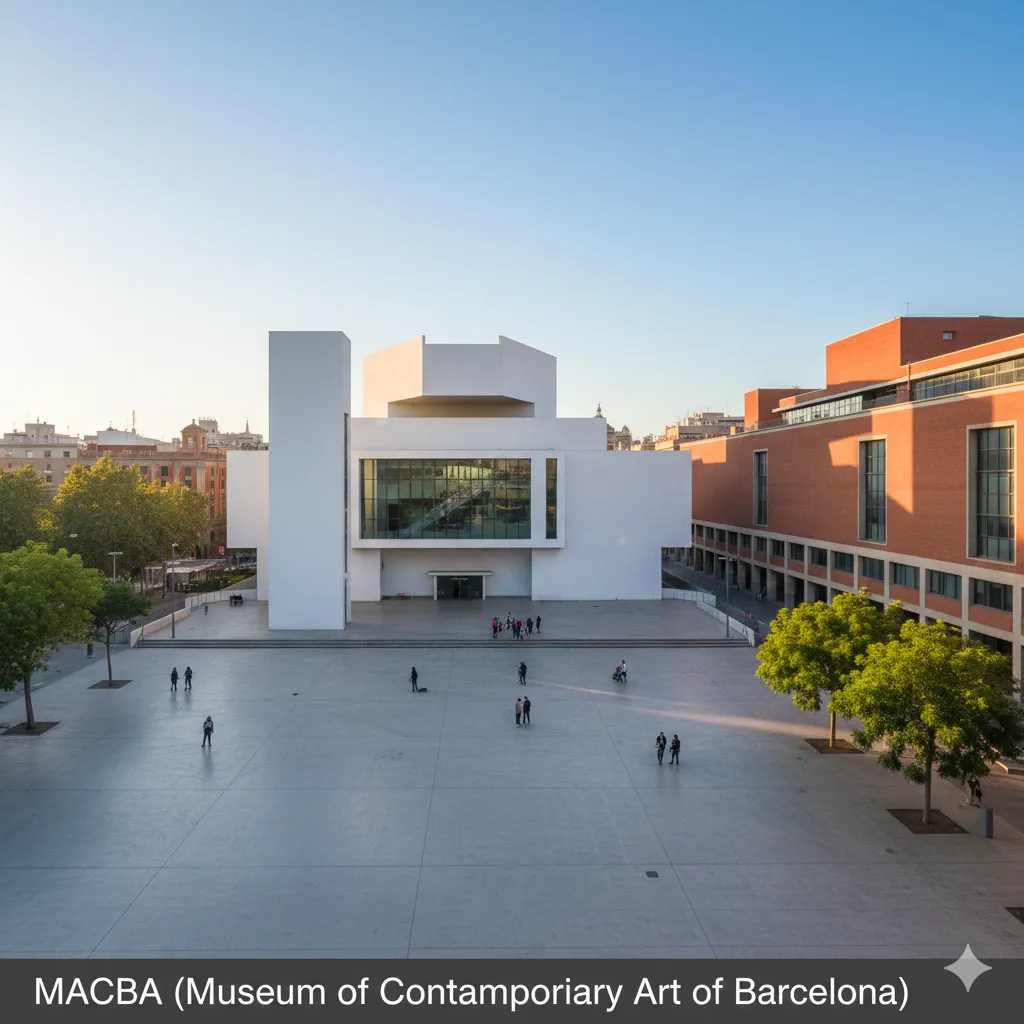
The clearest sign of the neighborhood's transformation is the MACBA (Museu d'Art Contemporani de Barcelona), designed by American architect Richard Meier and opened in 1995. Its stark white, light-filled building stands in deliberate contrast to the dense, worn streets around it.
The plaza in front of MACBA has an international reputation of its own: it's one of Europe's best-known skateboarding spots, and skaters gather there daily regardless of whether anyone's headed inside to see the art.
A short walk away is the CCCB (Centre de Cultura Contemporània de Barcelona), which opened in 1994 inside the restored 18th-century Casa de la Caritat, a former hospice. The pairing of a strikingly modern glass courtyard grafted onto a centuries-old building sums up how El Raval handles its history: preserved, but never precious about it. For a wider look at the city's art scene, see our guide to Barcelona's best museums.
Rambla del Raval: A Boulevard Built on Demolition
The Rambla del Raval is the neighborhood's widest, most open street, and it exists because a large stretch of dense, decaying housing was cleared to make room for it. The redevelopment ran from 1996 to 2001 and opened the boulevard in 2000, part of the same wave of regeneration that brought in MACBA and CCCB.
Its best-known landmark is a bronze cat sculpture by Colombian artist Fernando Botero, originally created in 1987 and installed on the boulevard in 2003. It's become the Rambla del Raval's default meeting point and one of the most photographed spots in the neighborhood.
Filmoteca de Catalunya: Cinema's Home in the Raval
Catalonia's official film archive, the Filmoteca de Catalunya, moved into a purpose-built home on Plaça de Salvador Seguí in 2012. It screens a rotating program of classic, restored, and independent film, and its ground-floor bar, La Monroe, is a low-key spot to end an evening even if you skip the screening.
Palau Güell: Gaudí Before He Was Famous
On the edge of El Raval, on Carrer Nou de la Rambla, sits Palau Güell, one of Gaudí's earliest major commissions, built between 1886 and 1888 for his patron Eusebi Güell. It predates his more famous later work by decades, and its parabolic arches and rooftop chimneys already show the style he'd spend the rest of his career developing.
Market Life on the Edge
El Raval's eastern boundary runs along La Rambla, right past the back entrance of La Boqueria. The market technically sits on the Gothic Quarter side of the line, but it's the closest major food market to most of El Raval, and locals treat the boundary as far more porous than any map does. Our full Boqueria Market guide covers what to buy and when to go to avoid the crowds.
Do's and Don'ts in El Raval
- Do visit the MACBA plaza in the late afternoon — it's when the skate scene is liveliest and the light on the white building is best for photos.
- Do check the Filmoteca de Catalunya's program in advance; screenings are often in original language with Catalan or Spanish subtitles.
- Don't assume all of El Raval feels the same. The blocks near Rambla del Raval and MACBA are polished and gallery-dense; some side streets further south retain a rougher, more lived-in edge.
- Don't skip the walk to Palau Güell just because it's less famous than Casa Batlló or Casa Milà — it's a genuinely early, formative Gaudí work.
Frequently Asked Questions
Why was El Raval called "Barri Xino"?
The nickname ("Chinatown") dates to the early 20th century, when the neighborhood's proximity to the port made it a dense, working-class quarter known for its nightlife and poverty, not for any specific Chinese community.
When did MACBA and CCCB open?
CCCB opened in 1994 inside the restored 18th-century Casa de la Caritat, and MACBA opened the following year, in 1995, in a new building designed by Richard Meier.
What is the Botero cat sculpture on Rambla del Raval?
It's a bronze cat sculpture by Colombian artist Fernando Botero, created in 1987 and installed on the boulevard in 2003. It's become the Rambla del Raval's unofficial meeting point.
Is Palau Güell worth visiting if I've already seen Casa Batlló?
Yes — it's one of Gaudí's earliest major works (1886-1888), built well before his more famous later projects, and shows the style he'd go on to develop for decades.
How dense and diverse is El Raval today?
It's home to roughly 47,000 people in just over 1 square kilometer, with an estimated 60% born outside Spain, making it one of Barcelona's most densely populated and internationally diverse neighborhoods.
Final Thoughts
El Raval doesn't hide its past the way some gentrified neighborhoods do. The contrast is the point: a former red-light district now anchors the city's contemporary art scene, a boulevard built by demolition hosts a beloved public sculpture, and a Gaudí building most tourists skip sits a few blocks from Europe's best-known skate plaza. Few Barcelona neighborhoods pack this much reinvention into this little space.